
Not All Ceramic Coatings Are Created Equal
The ceramic coating market is flooded. Every week there’s a new brand promising “9H hardness” and “lifetime protection.” But when you strip away the marketing, what actually separates a professional-grade ceramic coating from the spray-on consumer products sold at auto parts stores?
The answer comes down to three things: SiO2 concentration, application characteristics, and real-world durability. Understanding these factors will save you from wasting money on coatings that look great for two weeks and fail at three months.
SiO2 Concentration and Purity
Silicon dioxide (SiO2) is the backbone of any ceramic coating. Higher concentrations generally mean harder, more durable films. But concentration alone doesn’t tell the full story — the purity and particle size of the SiO2 matter just as much.
Cheap coatings use lower-grade SiO2 with inconsistent particle sizes. This creates an uneven film with weak spots that break down under UV exposure and chemical attack. Professional-grade coatings use nano-grade SiO2 with uniform particle distribution, creating a dense, consistent film that bonds at the molecular level.
When evaluating a coating, look beyond the percentage on the label. Ask about the grade of SiO2 used. A 70% coating with industrial-grade particles will underperform a 50% coating with pharmaceutical-grade nano SiO2.
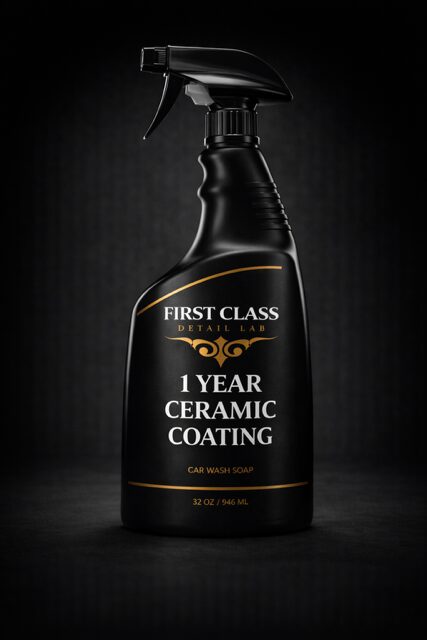
1 Year Ceramic Coating
SiO₂ Coating
First Class Detail Lab 1 Year Ceramic Coating is a professional-grade spray-on SiO₂ coating designed to deliver long-lasting hydrophobic protection with minimal application time.
Application Window and Forgiveness
Here’s where the rubber meets the road for professional installers: how does the coating behave during application? A great ceramic coating gives you a workable window — enough time to apply, level, and remove without panicking.
Some coatings flash almost instantly, turning every panel into a race against time. Others stay wet too long, leading to runs and uneven coverage. The sweet spot is a coating that gives you 30-60 seconds of working time per panel, flashes clearly so you know when to level, and wipes off cleanly without high spots.
Application forgiveness is critical for real-world use. You’re not always working in a climate-controlled booth. Temperature, humidity, and panel size all affect flash times. A great coating formula accounts for these variables and is designed to perform reliably across conditions.
Hydrophobic Performance Over Time
The true test of a ceramic coating isn’t how it beads water on day one — it’s how it beads water at month six, month nine, and month twelve. Consumer coatings often deliver impressive initial hydrophobics that degrade rapidly because the film was never dense enough to withstand real-world exposure.
Professional coatings maintain their hydrophobic performance because the SiO2 film is denser and bonds more completely to the clear coat. The contact angle stays high because the surface chemistry remains intact even after months of UV, chemical exposure, bird droppings, and mechanical washing.
When testing a new coating, the day-one result is meaningless. Install it on a daily driver and evaluate it monthly. If the water behavior at month ten looks like month one, you’ve found a winner.
Crystal-Clear Finish Without Hazing
One of the most frustrating problems with lower-quality coatings is hazing — a milky or rainbow-effect that appears on dark paint after curing. This is caused by uneven film thickness, incomplete leveling, or impurities in the coating formula.
A great ceramic coating cures crystal-clear on every color, including deep blacks and dark metallics where hazing is most visible. This comes down to formulation quality. Clean raw materials, proper solvent ratios, and consistent viscosity all contribute to a clear, glass-like finish.
If you’ve ever had to polish off a freshly cured coating because of hazing, you know how much time and credibility that costs. Invest in a coating that gets it right the first time.
Choosing a Coating You Can Warranty
As a professional installer, the coating you apply carries your reputation. You need a product you can confidently warranty — which means you need a product that will actually deliver on its stated durability.
Look for coatings from brands that provide clear, honest durability claims backed by real-world testing. Avoid brands that promise “lifetime” protection or “10H hardness” — these are marketing terms with no standardized testing behind them.
A honest 12-month coating that consistently delivers 12 months of protection is infinitely more valuable than a “5-year” coating that fails at 8 months. Your clients trust you. Choose a coating that honors that trust.
Leave a Reply